
Science is a method of asking awkward questions and subjecting them to reality checks, thus avoiding the human tendency to believe whatever makes us feel good


Rishi Raj
Professional Notions
I’m thrilled to invite you to explore my work, skills, and professional experience, and get to exchange your thoughts and ideas with me. It’s my firm belief that challenges are a great way to improve and grow, which is why I make a point of seeking out challenges in the professional realm as well as in my personal life. I very well understand that scientific research is about asking unaddressed questions and subjecting them to reality checks. Therefore, I want to use my skill sets, understandings, inquisitiveness, work ethics, and perseverance for contributing something significant to the scientific community. Take a moment to look around, and contact me directly to learn more.
My Research Summary
Background of the work
Since the 1960s, Epoxy/CF (Ep/CF)laminates have increased their volume percentage up to 50% in Boeing and Airbus aircraft structural parts. A laminate is a composite structure consisting of multiple layers of carbon fabric fused with the matrix resin. The superior strength to weight ratio (specific strength), corrosion resistance, design flexibility, lower manufacturing cost, and increasing fuel efficiency are some of the major advantages over the metal parts. However, Ep/CF laminates have several shortcomings such as failing catastrophically, due to lower damage tolerance in case a crack is generated (Mode I fracture toughness: 0.07-0.09 kJ m-2), deterioration of properties at higher temperature (Aero-frictional/engine heating), longer processing cycles (~10-12h) and post baking processes and need of large autoclaves thereby increasing the cost of manufacturing.
Therefore, We need a material solution that gives the production rate of metals and specific strength advantages of carbon fiber-based laminates- here Thermoplastic composites bridge this gap.
Polyetheretherketone (PEEK) is an established engineering thermoplastic material used in high-end applications. It can sustain very high temperatures (up to 180oC) during service. The mechanical properties of PEEK/CF are either superior or comparable to E/CF laminates. The damage tolerance (Mode I fracture toughness) of PEEK/CF is more than 10 times (1.5 to 2 kJ/m-2) than E/CF laminates. Also, the shorter production time using automation and absence of a long baking process reduce the overall manufacturing cost of the structures by 15-20%.
The problem at PEEK/CF interface
The major challenge in PEEK/CF laminates is their low interfacial strength. The surface energies of PEEK (28 mJ m-2) and CF (45-50 mJ m-2) have a large difference which contributes to poor interactions. Therefore, several attempts have been made in the past to increase the interfacial adhesion between PEEK and CF including plasma, laser, and chemical treatments. These methods introduce functional groups at the surface of CF which enhances the probability of interactions with PEEK by introducing functional groups and charges over CF surface. This increases the interfacial interactions between the PEEK matrix and CF. However, the improvement in the properties (ILSS and flexural strength) is not more than 40% in any of the all above-mentioned methods. The low improvement is attributed to the reduction in the intrinsic properties of CF due to oxidative degradation of CF by acid/plasma/laser treatment which damages its surface and produces defects. Therefore, the improvement in interfacial properties by conventional methods gets compensated by the reduction in intrinsic properties of CF. Moreover, the functionalization process is a multi-step and long process that lacks industrial scalability.
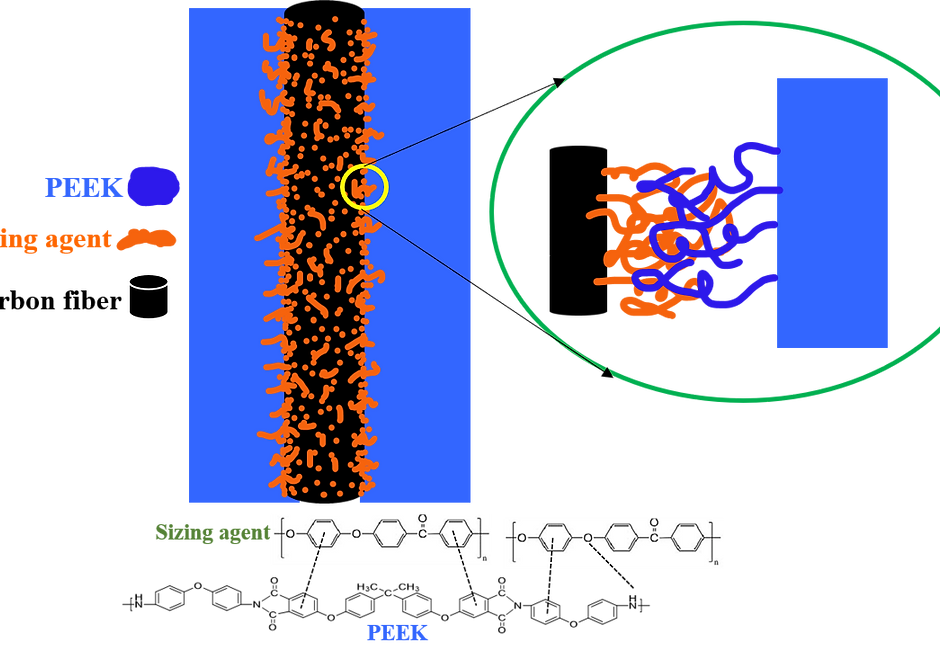
Therefore, a novel method to improve the interfacial adhesion is to introduce a low molecular weight polymer (sizing agent) at the surface of CF which is compatible and miscible with the PEEK matrix without disturbing the intrinsic properties of the CF. The commercial carbon fibers are coated with low molecular weight and partly cross-linked epoxy resin is coated to maintain its integrity and improve adhesion with the epoxy matrix. The coated resin is called a sizing agent. The sizing agent for PEEK/CF system requires suitable properties such as higher thermal stability and a similar chemical structure as PEEK. The processing temperature of PEEK is close to 400oC and the commercial epoxy sizing agent degrades at a higher temperature thereby deteriorating the interfacial properties.
The Objective of my research work
1. To design and synthesize thermally stable sizing agents to improve the interfacial adhesion of CF/PEEK laminates.
2. To study the effect of different properties of sizing agents such as molecular weight, chemical structure, etc. over the interface properties of CF/PEEK.
3. To study the effect of introducing nanomaterials such as Carbon nanotubes (CNTs) and Graphene oxide (GO) into the sizing agents and study their effect on the interface of CF/PEEK.
4. To characterize the interfacial properties with different tests and characterizations: Inter-laminar-Shear Strength (ILSS), Flexural tests (3-point bending), Fracture toughness (Mode-1), Fractography studies (Scanning electron microscopy).
Publications
1. Tuneable chemistry at the interface and self-healing towards improving structural properties of carbon fiber laminates: a critical review, Poulami Banerjee , Rishi Raj , S. Kumar * and Suryasarathi Bose, DOI: 10.1039/D1NA00294E (Review Article) Nanoscale Adv., 2021, 3, 5745-5776.
2. Effect of varying ratio of starch in melamine-formaldehyde/starch based adhesive and its properties, Rishi Raj & Susmita Dey Sadhu, Bulletin of Materials Science volume 44, Article number: 162 (2021),
Contact
Polymer processing group, Department of Materials Engineering, Indian Institute of Science, Bangalore
8076979084